
- Commercial Greenhouse
- Film Greenhouse
- PC Greenhouse
- Glass Greenhouse
- Tunnel Greenhouse
- Scientific Research Greenhouse
- Vegetable Greenhouse
- Flower Greenhouse
- Multi-span Greenhouse
- Sawtooth Greenhouse
- Greenhouse Equipments
- Greenhouse Accessories
- Hot Dip Galvanized Pipe
- Irrigation System
- Hydroponics System
- Planting Tools
- Planting technology
Tel: +86 191 5068 3942
Fax:
Mobile: +86 191 5068 3942
Contact: Alina
E-mail: sales@cngreenhouses.com
SKYPE:


Film Greenhouse vs Glass vs PC Sheet: Choosing a Cover
A film greenhouse against glass or PC sheet: cover cost per square metre, night insulation, service life, light, and where each of the three wins.
.
TEL:+86 191 5068 3942
- Features


A film greenhouse is chosen for one reason above the rest: the covering costs less per square metre than any rigid alternative, and what is saved goes into the frame, into climate equipment or into more covered ground. What it gives up is cover life. Film, glass and twin-wall polycarbonate sheet are weighed here as a trade of cover life against cover cost.
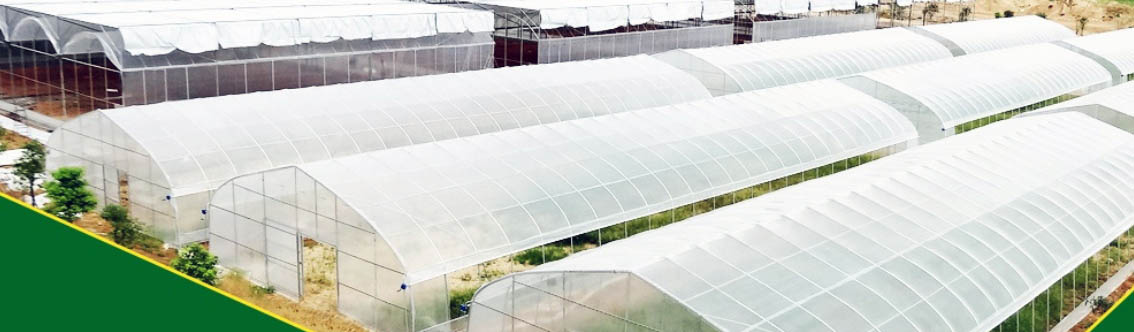
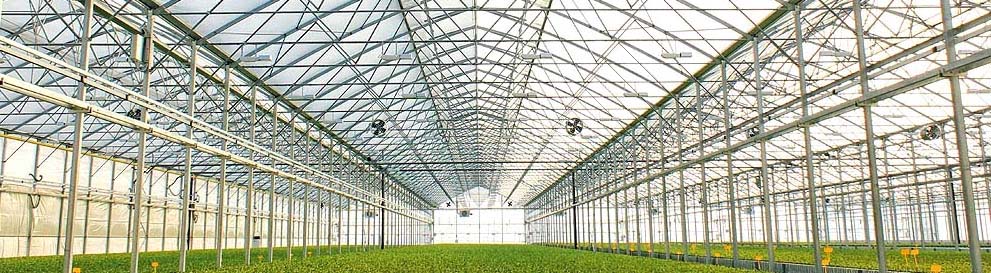
The house here is a multi-span film greenhouse, also called an agricultural plastic poly film greenhouse. It is framed in aluminum and hot dip galvanized steel pipe under an arch roof, covered with anti-PEP film on a grooved channel with aluminum clips, single or double layer. Spans of 6.4, 8, 9.6 or 10 metres are available, total structure height is 4.3 to 6.5 metres, and the covering thickness 0.15 mm or 0.12 mm.

Why the Covering Material Decides the House
A covering is not a finishing choice made after the frame is drawn, it sets the frame. Glass arrives in rigid panes and needs glazing bars, a load bearing structure and firmer foundations. Twin-wall polycarbonate sheet is lighter but still a panel with its own fixing profile. Film arrives as a roll pulled over the hoops and tensioned at a channel, so a pipe frame with a grooved channel and clips is the whole of the fixing.
The covering also fixes the light and heat balance before a crop is planted. A rigid cover carries more weight, and twin-wall sheet sends light through two walls and an air cell, which is why a PC house holds warmth better than a single glazed one.

Film, Glass and PC Sheet on Five Counts
- Cover cost per square metre. Film is roll goods, so the cover itself is lowest of the three. Twin-wall sheet sits in the middle. Glass is highest on the pane alone, and higher again with glazing bars and the heavier frame.
- Weight carried by the frame. Film adds almost nothing, which is why a galvanized pipe frame is enough. Twin-wall sheet adds a moderate load and needs closer purlin spacing. Glass needs the heaviest structure.
- Light reaching the crop. Clear film transmits well, a single layer best. Glass transmits most of all and holds its figure for decades. Twin-wall sheet transmits less clear light, the path crossing two surfaces and an air cell.
- Insulation at night. A single film sheet is thin and loses heat readily, which is why the double layer with air between the sheets exists. A twin-wall panel is a built-in air cell and beats single glass, the weakest of the three unless double glazed.
- Service life of the cover. Film has the shortest life and is re-covered periodically. Twin-wall sheet lasts far longer and glass longest, which is what the extra cost buys.
Two of those counts are worked through elsewhere: polycarbonate sheet against glass, and the practical business of extending the service life of plastic film.
Where Film Wins, and Where a Rigid Cover Wins
Film wins where the covered area is large, the site is uneven or the house must be up quickly. A light pipe frame stands on ground that would need levelling under glass, and on a long multi-span house the cover cost is multiplied by a large area, so the saving per square metre becomes decisive. It also wins where the house is a working tool: a damaged cover is repaired with a roll and clips.
The frame under this covering suits that case: a simple and effective solution for varied and complex topographic conditions, quoted to the customer's own drawing rather than a fixed footprint. A rigid cover wins where a climate must be held tightly for many years: glass and sealed twin-wall sheet hold heat and humidity more steadily, and need no re-covering cycle.
Light, Heat Loss and Cover Life in Practice
What a film cover does is narrower than the marketing suggests. It gives a long lasting covering with good light transmission, UV protection and tensile strength, and on this model it prevents heat loss and cold air intrusion, with good insulation properties and low energy consumption. The mechanism is the layer: one sheet keeps the wind off the crop, two sheets with air held between them slow the rate at which heat leaves after sunset.
The frame is hot dip galvanized steel pipe, and the galvanizing is the answer to rust. Its working life is assessed under ISO 9223 and BS EN ISO 14713-1 against the corrosivity class of the site, class C2 in clean country air through C3 urban and C4 industrial to C5 coastal, each with its own maintenance expectation. The cover is held by a grooved channel frame that reinforces it against wind and weather, and the structure carries a 20-year structural warranty.
Frame, Cover and Add-On Data for This Model
Type: film greenhouse, multi-span. Frame: aluminum and hot dip galvanized steel pipe, arch roof, total structure height 4.3 to 6.5 metres, spans of 6.4, 8, 9.6 or 10 metres. Cover: standard clear greenhouse film at 6 mil, thickness 0.15 mm or 0.12 mm, polyethylene held with aluminum clips, single or double layer. Working size 64 m by 40 m, area 2,560 square metres, materials plastic and mesh, middle scale, design wind load 0.35 kN/m2, ventilation manual or electric, exported globally. Crops: vegetable, fruit, flower and seed nursery.
Additions quoted as their own lines are cooling and heating, irrigation, ventilation, fertilization, shading and benches. Custom-cut lengths are available on many film styles, so the cover can be ordered in the exact amount needed. A house is packed in three groups: metal structures, covering system and install accessories. Samples are free, with the freight on a sample delivery borne by the customer.

The wider range this covering belongs to is under our polyethylene film greenhouses, and the rigid covers it is set against with the glass greenhouses we build and the polycarbonate sheet houses. Reporting on how commercial growers run covered houses is published by HortWeek, and guidance on covered structures by the National Greenhouse Manufacturers Association. To weigh film against a rigid cover on your own site, call +86 191 5068 3942 or write to sales@cngreenhouses.com with the ground area and the crop.
Frequently Asked Questions
Q: Why choose a film greenhouse over a glass or polycarbonate house?
The cover costs least per square metre and the frame it needs is light, so a large area is covered for less, and repair is a roll and clips rather than replacement panes. What is given up is cover life.
The cover costs least per square metre and the frame it needs is light, so a large area is covered for less, and repair is a roll and clips rather than replacement panes. What is given up is cover life.
Q: How do film, glass and twin-wall PC sheet differ in service life?
Film has the shortest life and is replaced periodically. Twin-wall polycarbonate sheet lasts far longer and glass longest. The extra cost of a rigid cover largely buys that longer life.
Film has the shortest life and is replaced periodically. Twin-wall polycarbonate sheet lasts far longer and glass longest. The extra cost of a rigid cover largely buys that longer life.
Q: Is a film house as warm as a glass house at night?
A single film sheet is thin and loses heat readily, so single film against single glass is not where a film house wins. The insulation is the double layer with air held between the sheets, and that is what lets a film house sit closer to a rigid house overnight.
A single film sheet is thin and loses heat readily, so single film against single glass is not where a film house wins. The insulation is the double layer with air held between the sheets, and that is what lets a film house sit closer to a rigid house overnight.
Q: What frame, span and cover figures apply to this model?
Frame of aluminum and hot dip galvanized steel pipe, arch roof, height 4.3 to 6.5 metres, spans of 6.4, 8, 9.6 or 10 metres. Cover is standard clear film at 6 mil, 0.15 mm or 0.12 mm, held with aluminum clips, single or double layer. Working size 64 m by 40 m, area 2,560 square metres, wind load 0.35 kN/m2, ventilation manual or electric, 20-year structural warranty.
Frame of aluminum and hot dip galvanized steel pipe, arch roof, height 4.3 to 6.5 metres, spans of 6.4, 8, 9.6 or 10 metres. Cover is standard clear film at 6 mil, 0.15 mm or 0.12 mm, held with aluminum clips, single or double layer. Working size 64 m by 40 m, area 2,560 square metres, wind load 0.35 kN/m2, ventilation manual or electric, 20-year structural warranty.
Q: Can cooling, irrigation or shading be added later?
Cooling and heating, irrigation, ventilation, fertilization, shading and benches are available on request and quoted as their own lines. They are additions to the house, so they do not change the film, glass or sheet comparison.
Cooling and heating, irrigation, ventilation, fertilization, shading and benches are available on request and quoted as their own lines. They are additions to the house, so they do not change the film, glass or sheet comparison.
Q: Are samples free, and who pays the freight?
Samples of the greenhouse products, including film cover components, are free, with the freight on a sample delivery borne by the customer. The company has manufactured in its own factory for above 35 years and can send an engineer to guide installation.
Samples of the greenhouse products, including film cover components, are free, with the freight on a sample delivery borne by the customer. The company has manufactured in its own factory for above 35 years and can send an engineer to guide installation.
Note: If you're interested in the product, please submit your requirements and contacts and then we will contact you in two days. We promise that all your informations won't be leaked to anyone.
 Deutsch
 Español
 Français
 Italiano
 Português
 日本の
 한국어
 العربية
 български
 hrvatski
 česky
 Dansk
 Nederlands
 suomi
 Ελληνικά
 हिन्दी
 norsk
 Polski
 Română
 русский
 Svenska